
Our Journey
So where did this all start? It is said that every business is conceived with a flash of inspiration – a light bulb moment in the mind’s eye of the founder. My moment of inspiration came on my first day of university in South Africa, and it literally involved a light bulb.
My room-mate was the first person in his family and indeed his village to go to college. While I was excited about all the parties in Freshers’ Week, I asked him what he was most looking forward to: he told me it would be the first time in his life that he would have a light in his room to study at night. This moment with my friend Given, who is now a leading IT expert in the mining industry, remains an inspiration to me.
Africa New Energies was founded with a simple vision – to find a way to give 630 million Africans electricity for the first time.
Despite the years that have passed, two thirds of sub-Saharan Africans still lack electricity to study, work, and live. After two decades working in the energy industry, I finally got my opportunity to do something about it. In 2011, I was funded by the UN to help the Namibian Government electrify a country where the majority of the population has never had access to the grid. We longed to use solar – after all, this is the sunniest country on earth, but we found that it would be financially impossible. A universal access programme based on solar electricity would cost $12 billion (almost 1 year of GDP in 2011), and bankrupt the country as the government paid back the loan in USD with compound interest of 10%.
After modelling the alternatives, we came up with the only financially feasible solution – the first stage was to locate onshore natural gas, turn it into electricity on-site and feed it into the national grid, off-setting coal imports. At $600 million it would cost one twentieth of the solar electricity programme and be highly profitable. In a second stage, these profits would be used to provide free solar energy for all those in Namibia not connected to the grid.
The Namibian government agreed that this was an appealing solution, but lacked the skills and funds to implement it themselves. Instead they offered us the opportunity to buy an onshore concession and put our own plan into practice. In November 2012 I founded Africa New Energies with my long term business partner Brendan Raw to do just this.
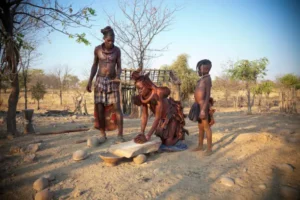
But we still had a problem; natural gas had never been found in commercial quantities in Southern Africa – except in Mozambique, 1300km away. It seemed as though the project would remain a pipe dream, until we encountered the encyclopaedic knowledge of the local San, Herero and Nama people of the Kalahari. The late Paramount Chief of the Herero, a supporter of our work in Namibia, rallied local communities to come forward with knowledge of local oil seeps.
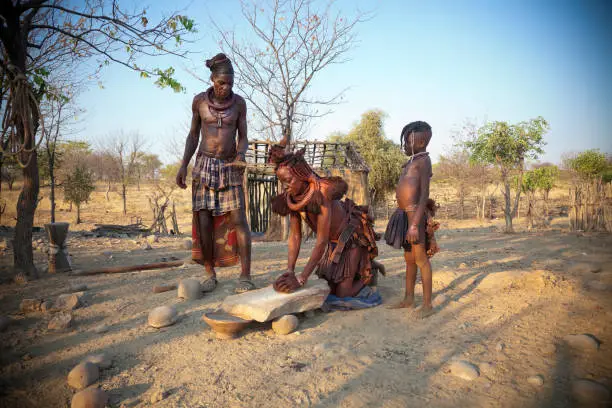


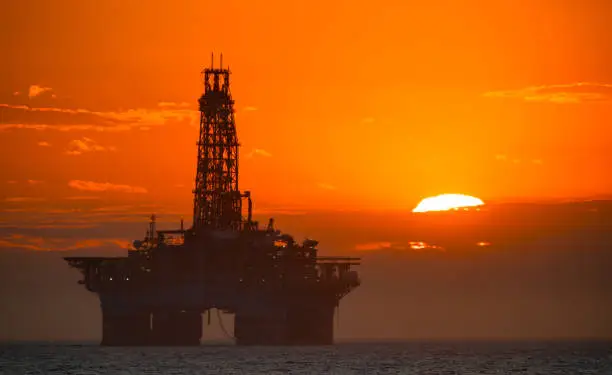

A farmer alerted us to a strange dark gunge in his water well every morning – scientific tests indicate that it sits in the middle of a 300-million- year-old oil field. On one occasion a farmer told us of a strange dark gunge that came up every morning when he switched on his water well pump. We collected it and the liquid was indeed darker. The smell gave me a strange sense of déjà vu – a reassuring feeling of nausea that reminded me of the smell of methane coming from the Bunsen burner I used as a ten-year old aspiring chemist. The community was right – $25,000 later, three North American labs confirmed this was indeed oil and gas, formed 300 million years ago when present-day Botswana was a vast shallow inland sea.
We were still a long way from getting it out of the ground. A conventional exploration programme would have cost $150 million, with at best a one-in-four chance of success. Instead of pursuing this funding from institutional investors, we decided to reduce our costs and get crowdfunded. This would allow us to maintain controlling stakes in the company and use innovative, non-industry standard exploration techniques.
We have spent the last few years developing an integrated surface exploration algorithm to analyse seventeen layers of data gathered from satellite, light aircraft and ground surveys. Many of the individual data gathering techniques have been back-tested on thousands of proven wells around the world. Integrating these layers of data triples the overall probability of drilling success at one tenth of the cost of industry standard methods.
Applying the algorithm to the areas that the local community alerted us to indicated thirty-two potential oil and gas fields, with potentially billions of barrels of oil. Indeed, the water well containing methane sits in the middle of a potential giant oil field half the size of London. On the strength of these findings we applied for, and were awarded, a concession area bigger than Wales on the most advantageous terms industry experts had seen in 40 years.